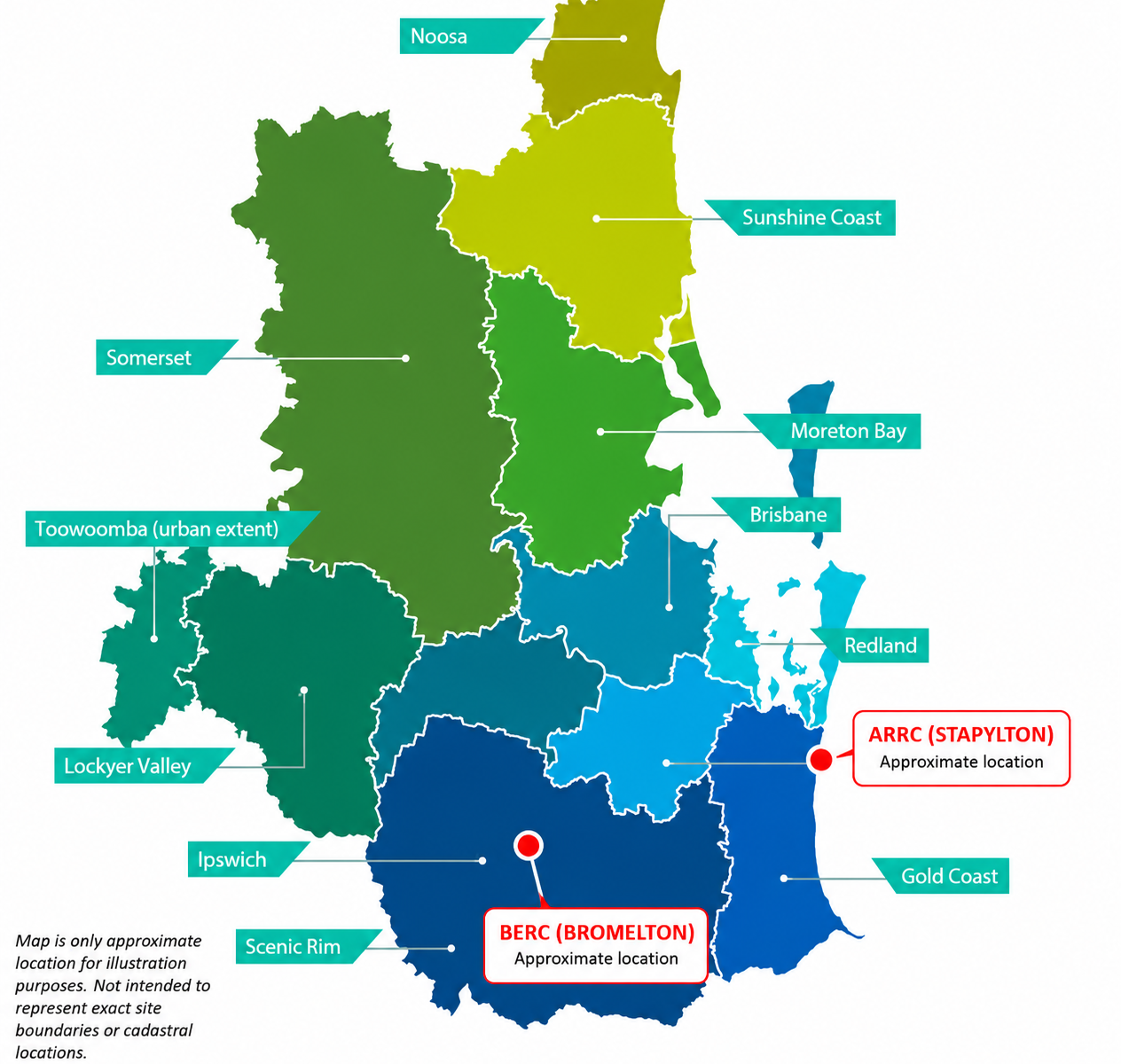
The Stapylton waste-to-energy proposal rarely gets discussed in the same breath as BERC. Each project gets treated as its own decision, its own approval, its own future. But what if both get up?
What happens if Stapylton gets approved too?
It’s not a hypothetical worth dismissing. The economics of waste-to-energy run on one thing above everything else: a guaranteed, continuous supply of waste. Take that away, or split it, and the whole financial case shifts.
Feeding the Beast
BERC is designed to process around 760,000 tonnes of waste a year. Over a 30-year operating life, that’s roughly 22.8 million tonnes. The facility doesn’t just need waste at opening, it needs committed waste for decades.
Supporters point to South East Queensland’s growing population and rising waste volumes. Fair enough. The numbers look workable in isolation. But isolation is the problem. What happens when two large-scale facilities are drawing from the same regional pool at the same time?
The Stapylton Factor
If a major waste-to-energy facility at Stapylton is approved alongside BERC, South East Queensland would be running two competing operations chasing the same feedstock. The question changes entirely. It’s no longer “is there enough waste for BERC?” It becomes “is there enough committed waste for both, long-term, under contract?”
No publicly available evidence shows how competing facilities would divide future waste streams, council contracts, commercial volumes, or industrial sources. Those contracts are the foundation of financial viability. Without them, the numbers don’t hold.
Lessons from Western Australia
Western Australia is the only Australian jurisdiction with large-scale waste-to-energy operating at anything close to this scale. The Kwinana and East Rockingham facilities together process roughly the same volume BERC proposes to handle alone. Both projects required substantial financial backing, experienced delays, went through refinancing pressure, cost escalation, and administration proceedings.
The lesson isn’t that waste-to-energy can’t work. The lesson is that these projects depend entirely on long-term certainty. Certainty of waste supply. Certainty of contracts. Certainty of revenue. When those foundations shift, the financial pressure comes fast.
KC VICE has previously examined the broader health and environmental concerns surrounding BERC.
The Taxpayer Question
If two facilities end up competing for the same waste stream and volumes fall short, who carries that risk? Private investors? Waste companies? Councils? Ratepayers?
Right now that might look like a hypothetical. It won’t stay that way once billion-dollar infrastructure is in the ground and councils are locked into it for disposal. Governments don’t walk away from essential services when commercial assumptions fail. Airports, ports, toll roads, rail projects, and energy infrastructure have all tested that reality. Waste-to-energy won’t be different.
Questions Worth Asking
Before any approval is granted, the community deserves straight answers:
- How much waste has already been contractually secured for BERC?
- How much depends on agreements that don’t exist yet?
- What impact would a Stapylton approval have on BERC’s feedstock assumptions?
- Has any modelling examined what competition between two facilities actually looks like?
- What happens if projected waste volumes aren’t achieved?
- Would governments be expected to step in if financial performance falls short?
These aren’t anti-development questions. They’re risk management questions. There’s a difference.
The Bigger Picture
This isn’t about picking one project over another. It’s about whether South East Queensland’s waste strategy is being planned as a coordinated system or as a race between competing private interests chasing the same resource.
If multiple facilities end up fighting for the same waste stream, the public deserves to understand that risk before approvals are signed, not after the concrete is poured.
The question was never whether there’s enough waste today. The question is whether there’ll be enough guaranteed waste tomorrow, under contract, for 30 years, across two facilities.
That answer isn’t nearly as clear as the proponents would have you believe.