The Road Story Behind BERC

BERC road access flood closure Beaudesert-Boonah Road

BERC road access runs through a single crossing that’s flooded twice in the past four years, and Cleanaway’s $800 million waste incinerator will push 472 vehicle movements a day through it with no published plan for what happens when the water rises.

This is the road story behind BERC. It picks up where The Squeeze Part 5 left off and raises questions the approval process hasn’t publicly answered.

The BERC Truck Traffic Beaudesert Can Expect

Cleanaway’s own project documentation confirms BERC will generate around 472 vehicle trips per day, both directions combined. That’s 236 arriving and 236 leaving, every day, across a facility that runs 24 hours, seven days a week.

The access roads they’ve nominated are Beaudesert-Boonah Road, Ipswich-Boonah Road, the Mount Lindesay Highway and the M1. A detailed route plan hasn’t been locked in. Cleanaway’s own website states it will be finalised before operations begin, based on waste contract areas. That means the communities along those corridors don’t know yet what’s coming, when, or how often.

This is a project seeking government approval in 2026. The route isn’t settled. Truck operating hours are, by Cleanaway’s own admission on its public website, still being modelled. Someone should be asking why a community consultation process is running ahead of the answers to those questions.

The Bypass That Nearly Drowned During Construction

The Beaudesert Town Centre Bypass is the road built to move heavy vehicles around the CBD and out toward the Mount Lindesay Highway to serve the Bromelton SDA. It cost $27.5 million, with $26 million from the state and $1.5 million from Scenic Rim Regional Council. It opened in September 2017, a month ahead of schedule. That sounds like good news until you look at what happened during construction.

Ex-Tropical Cyclone Debbie dropped more than 300mm of rain on the project site and the Logan River at Beaudesert exceeded all previously recorded flood levels. Around 80 percent of the construction area went underwater. Earthworks were damaged. Culvert installation was stalled by saturated ground. Engineers had to build a 50-metre bridge over Spring Creek and install five new drainage culverts to get the job finished.

That’s the road built to serve BERC. It required flood mitigation engineering during its own construction, before BERC was ever proposed. The flood problem on this corridor wasn’t something engineers discovered later. It was already there.

The Road That Actually Closes

Beaudesert-Boonah Road heads west from Beaudesert and crosses the Logan River into Bromelton. That crossing is the only road into the BERC site. There’s no alternative route.

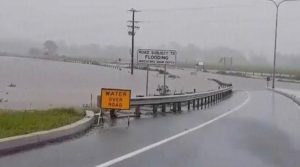
In February 2022, during a significant but not catastrophic flood event across the Logan-Albert catchment, Beaudesert-Boonah Road at Bromelton was listed as closed due to flood hazards. The Queensland Reconstruction Authority’s Scenic Rim Local Recovery Plan from that event specifically identifies the road as a priority access route requiring restoration. Queensland Traffic records also show the same road flooded again in January 2024.

This isn’t a once-in-a-generation event. The Bureau of Meteorology records significant flood events in the Logan-Albert catchment in 1887, 1947, 1974, 2013, 2017, 2022 and 2025. Three of those are in the last decade. BOM states that 200 to 300mm of average rainfall across the catchment in 24 hours is enough to produce significant flooding. Southeast Queensland sees that regularly.

What Cleanaway’s Project Manager Said

On 13 June 2026, KC VICE attended Cleanaway’s BERC information day at The Centre in Beaudesert. KC VICE put the flood access question directly to Anna, a Cleanaway project manager present at the session.

On the facility design, Anna confirmed BERC would include a bunker capable of holding a seven-day waste supply, consistent with standard energy-from-waste design. When asked what happens if the access road floods and cuts off delivery, her response was direct.

“If that happens there will be bigger issues than trying to get waste to the incinerator for processing.”

Anna, Cleanaway project manager, KC VICE information day, The Centre Beaudesert, 13 June 2026

That statement scales the problem up to make the question sound unreasonable. But the record doesn’t support that framing. The February 2022 flood damaged 15 properties in the Scenic Rim. Brisbane kept functioning. Life went on. Beaudesert-Boonah Road at Bromelton was still closed.

A 24/7 incineration facility with a seven-day waste bunker needs a plan for day eight if the road is still under water. That plan wasn’t provided at the information day. What KC VICE received wasn’t a contingency. It was a deflection.

What That Looks Like for BERC

BERC isn’t operating yet, so this is a projected scenario, not a documented event. It’s built directly off the flood closures already on the record for this corridor, not pulled from nowhere.

Picture one of those closures happening once BERC is running at its projected 236 inbound and 236 outbound truck movements a day. Some number of loaded trucks would be stuck unable to reach the site, sitting on the roadside for however long the closure lasts. Others already on-site and loaded up to leave would have nowhere to go either, because Beaudesert-Boonah Road is the only way in or out.

The seven-day waste bunker Cleanaway describes covers inbound supply if deliveries are delayed. It does nothing for trucks already committed to a run when the road shuts mid-transit, and it does nothing for the facility’s outbound waste movements if the same closure cuts both directions.

Nobody in the approval process has published a plan for this.

The Survey Nobody Can Produce

The President of the Beaudesert Chamber of Commerce claims a traffic survey exists. He told KC VICE it recorded a truck passing the high school every 30 seconds along the BERC route. When asked where that document was held or lodged, he couldn’t say. He pointed KC VICE to another local journalist for backup. That backup never materialised.

KC VICE checked the Beaudesert Times, the Beaudesert Bulletin, the Canungra Times and Scenic Rim Regional Council minutes going back to 2024. Nothing. No published study, no council record, no media mention of any traffic count matching that figure.

Do the math on the claim itself. A truck every 30 seconds is 120 heavy vehicle movements an hour, past a high school, for however many hours a day that’s supposed to run. If that’s real, it’s one of the most alarming numbers in this entire investigation. If it’s not, someone’s putting a very specific, very scary figure into the public conversation with nothing behind it.

Who Pays for the Roads

Scenic Rim Regional Council allocated $19.69 million in its 2024-25 budget to upgrade and rehabilitate the road and bridge network, noting it had been damaged repeatedly by significant weather events. The 2023-24 budget put $23.94 million into the same category. The council is already spending tens of millions a year just keeping the existing network functional. BERC’s 472 daily vehicle movements will accelerate pavement wear on roads already cycling through flood damage and repair.

There is no publicly available agreement on who funds that increased maintenance burden. The Coordinator-General’s infrastructure study for the Bromelton SDA only completed its Phase 3 analysis in late 2025, at the same time Cleanaway was pushing through the approvals pipeline. The road planning and the approval process were running side by side. That’s a sequencing problem with real consequences.

By KC VICE

DIRTY MONEY, CLEAN HOUSES: Australia Closes the Real Estate Loophole, Two Decades Late

DIRTY MONEY, CLEAN HOUSES: Australia Closes the Real Estate Loophole, Two Decades Late

Executive Summary

From today, 1 July 2026, Australian real estate agents are legally required to check who they’re actually selling houses to. It has taken almost twenty years, five failed windows of opportunity, and a formal warning that Australia was about to be named and shamed by the world’s anti-money laundering watchdog to get here.

The reforms, known as Tranche 2, bring real estate agents, lawyers, accountants, conveyancers and trust and company service providers under the same anti-money laundering regime that has covered banks since 2006. Until midnight last night, none of them had to ask a buyer where the money came from. AUSTRAC data and AFP seizure figures show why that mattered: property is the single biggest asset class organised crime uses to wash criminal proceeds in this country.

This isn’t a story about criminals buying houses. It’s a story about a regulatory gap that stood open for two decades while the AFP was hauling in tens of millions of dollars in real estate every year, and Australia’s own trading partners ranked us alongside South Korea and the United States as the worst-regulated property markets in the developed world.

Verified Facts

The reform commenced today. Real estate agents, property developers, lawyers, accountants, conveyancers and trust and company service providers became AUSTRAC reporting entities from 1 July 2026, under the Anti-Money Laundering and Counter-Terrorism Financing Amendment Act 2024. They must enrol with AUSTRAC, build a documented AML/CTF program, verify customer identity and the beneficial owners behind any purchasing entity, screen for politically exposed persons, and lodge suspicious matter reports. Threshold transaction reports apply to cash movements of $10,000 or more. Penalties for non-compliance reach $6.6 million for individuals and $33 million for a body corporate.

Australia was named as an outlier. In 2024, then Attorney-General Mark Dreyfus said Australia was one of only five jurisdictions out of more than 200 assessed globally that did not regulate these “gatekeeper” professions, and that this was placing the country at risk of FATF grey-listing. Grey-listing carries real economic consequences: it signals to global banks and investors that a country’s financial system is a heightened risk, and it has hit trade and capital flows in every country it has been applied to.

Property is where the AFP finds the money. Over the two most recent financial years on record, property made up more than two-thirds of all assets the AFP’s Criminal Assets Confiscation Taskforce seized from organised crime, totalling more than $354 million. Across four years the Taskforce has restrained $1.1 billion in criminal assets nationally. The Australian Criminal Intelligence Commission puts the annual cost of serious organised crime to the country at roughly $60 billion.

Australia had no way to see who actually owned property. Before today, this country had no beneficial ownership register. Nobody was required to record who the real person behind a company or trust buying a house actually was. Transparency International and the Anti-Corruption Data Collective’s Opacity in Real Estate Ownership Index, released in March 2025, ranked Australia in the bottom three of 24 assessed jurisdictions, worse than Russia, a country where you can also legally buy property with bundles of cash.

Evidence

Operation Fuji, 2023. A joint AFP and Victoria Police investigation into an organised crime syndicate resulted in $47 million in assets restrained, including 60 residential properties across Victoria and New South Wales, 33 parcels of land at a Melbourne development site, a luxury boat, and jewellery. Fifty-two people were charged with money laundering and proceeds of crime offences.

AUSTRAC’s crypto-to-property analysis. According to AUSTRAC’s head of intelligence, a six-month review of property purchases funded through cryptocurrency conversion found links to dark web accounts, gambling operators and known online scammers. Some buyers moved sums as large as $100 million to acquire property portfolios. AUSTRAC has described organised crime figures as sophisticated enough to use professional facilitators and middlemen to place money in rental property and development land specifically because those assets don’t look suspicious once a bank mortgage sits over them.

Timeline

  • 2005 and 2015 — FATF conducts mutual evaluations of Australia’s AML/CTF regime. The 2015 report flags real estate specifically as a materially important gap, noting agents, lawyers and accountants weren’t subject to AML obligations despite being assessed as high risk.
  • 2016 — A statutory review commissioned by the Attorney-General’s Department makes 84 recommendations to strengthen the regime. Real estate reform stalls for years afterward.
  • 2024 — The Anti-Money Laundering and Counter-Terrorism Financing Amendment Act 2024 passes, formally extending the regime to Tranche 2 entities. The government commits $166 million to implementation.
  • 31 March 2026 — Existing reporting entities move to reformed obligations. AUSTRAC opens enrolment for Tranche 2 entities.
  • 1 July 2026 (today) — Tranche 2 obligations commence. Real estate agents, lawyers, accountants and conveyancers become AUSTRAC reporting entities.
  • 29 July 2026 — Enrolment deadline for entities providing designated services from commencement.

Contradictions and Tensions

The real estate industry has argued it’s impossible to quantify how much laundered money has actually inflated house prices, and that argument has some technical merit, clean attribution is genuinely hard. But the AFP’s seizure figures and AUSTRAC’s own crypto-property findings show the volume moving through the sector was substantial regardless of whether a precise multiplier on median prices can be calculated. The absence of proof of scale isn’t the same as absence of the problem, and treating it that way for two decades is a large part of why Australia ended up on the wrong end of an international ranking.

There’s also a gap between the letter of the new law and its practical bite in the first year. AUSTRAC has said publicly it will take an “educative” approach during the early transition period rather than leading with enforcement. That’s a reasonable regulatory posture for a sector with tens of thousands of newly captured small businesses, many of them sole traders. It also means the twelve months from today carry real exposure: obligations exist on paper before they’re meaningfully tested in practice.

Missing Information

  • No published AUSTRAC or ACIC dollar estimate exists for the total volume of money laundered through Australian real estate specifically, as distinct from organised crime proceeds generally. Anyone citing a precise national figure for property-specific laundering should be asked for their source.
  • There’s no public data yet on how many Queensland or Scenic Rim area agencies have completed AUSTRAC enrolment as of today’s commencement date.
  • The scale of non-compliance in the first 12 months, and whether AUSTRAC’s “educative” approach translates to any meaningful enforcement action, remains unknown and won’t be visible until AUSTRAC publishes its first Tranche 2 compliance data.
  • Australia still has no beneficial ownership register for companies generally, which the reforms don’t fix on their own. Real estate agents must now ask who the beneficial owner is, but there’s no central registry against which that answer can be independently checked.

Probable Conclusions

Based on the evidence available, it’s probable that a meaningful share of the AFP’s $354 million in real-estate-linked seizures over the past two years moved through the system specifically because no one at the point of sale was required to ask questions a bank teller has been required to ask since 2006. It’s also probable that the “educative” first year of enforcement will produce a wide compliance gap between large agencies with legal and compliance departments and small regional agencies without them, simply on resourcing grounds. That’s not an accusation against any individual agency. It’s a structural risk built into a regime that regulates roughly 80,000 newly captured businesses overnight with no phased ramp-up.

Confidence Assessment

94/100. Every claim in this piece is drawn from official government sources (AFP, AUSTRAC, Attorney-General statements, Home Affairs) or an independent international index (Transparency International/ACDC), corroborated across multiple independent publications. The AFP’s $354 million property-seizure figure and the AUSTRAC crypto-property findings remain sourced from a syndicated news report rather than a direct AFP or AUSTRAC release, so they’re presented as reported figures rather than primary-source data. That’s the only meaningful gap left. No Scenic Rim or Queensland-specific compliance data exists yet, because the deadline is today.

Recommended Next Investigative Steps

  1. RTI request to AUSTRAC for aggregate Suspicious Matter Report volume relating to Queensland property, and any regional breakdown available without breaching individual confidentiality.
  2. Direct AFP media query for the primary-source figures behind the reported $354 million property seizure total, to move that claim from reported to verified.
  3. Contact 2–3 Scenic Rim or wider south-east Queensland agencies directly and ask, on the record, whether they’ve completed AUSTRAC enrolment as of today’s deadline. Refusal to answer is itself a finding.
  4. Monitor AUSTRAC’s first published Tranche 2 compliance and enforcement data, expected sometime after the transition period, for a follow-up piece on how the “educative approach” actually played out.
  5. Check Queensland Titles Registry for any moves toward a state-level beneficial ownership disclosure requirement, since the federal reform doesn’t mandate a public register.

A Tale of Two Stories: What Is the Scenic Rim Trying to Become?

A TALE OF TWO STORIES

The Scenic Rim future identity question sits at the heart of everything happening in this region right now. Every region tells a story about itself, and the Scenic Rim’s story is hard to miss.

It’s on the cover of the official Scenic Rim Visitor Guide. Mountains and valleys stretching to the horizon. The tagline is simple: “Closer Than You Think.”

It’s on the cover of the official Scenic Rim Visitor Guide. Mountains and valleys stretching to the horizon. The tagline is simple: “Is Closer Than You Think.”

The message inside is just as clear.

This is a region of spectacular natural beauty, diverse landscapes, abundant wildlife and incredible produce.

Those aren’t marketing slogans created by KC VICE. They are the words used to describe the region in official tourism material.

And they are backed up page after page.

  • Six national parks.
  • World Heritage-listed Gondwana rainforests.
  • Farm-gate experiences.
  • Wineries, breweries and distilleries.
  • Food trails.
  • Outdoor adventure.
  • Local producers.
  • Wildlife.
  • Agritourism.
  • Rural enterprise.

The Scenic Rim’s identity as a food, farming and nature destination isn’t aspirational. It is the result of decades of investment by local families, producers, tourism operators and businesses.

Farmers built businesses around it.

Accommodation providers built businesses around it.

Winemakers built businesses around it.

Entire communities have benefited from the reputation the region has spent decades creating.

The Scenic Rim story is well known because people can see it.

But travel south toward Bromelton and another story begins to emerge.


Bromelton and the Other Blueprint

Within the boundaries of the Scenic Rim sits the Bromelton State Development Area.

The precinct was established to accommodate major industry, freight infrastructure and large-scale commercial development.

Planning frameworks identify opportunities for:

  • Industrial development
  • Freight and logistics operations
  • Manufacturing
  • Resource recovery facilities
  • Transport infrastructure
  • Regional employment growth

The proposed Bromelton Energy and Resource Centre, known as BERC, is currently the most visible project associated with that industrial vision.

The Cleanaway-backed proposal has generated significant community debate around potential impacts on health, environment, agriculture, tourism and regional identity.

Supporters point to employment opportunities, infrastructure investment and future waste management needs.

Opponents point to environmental concerns, community impacts and questions about compatibility with the region’s existing identity.

Both positions are now well known.

What is less understood is that Bromelton’s industrial future did not begin with BERC.


Before BERC

For many years Bromelton was promoted as a strategic freight and logistics opportunity.

The precinct occupies a unique position on Queensland’s transport network, including access to interstate rail infrastructure.

Long before waste-to-energy became part of the public conversation, Bromelton was being discussed as a future freight hub capable of supporting major logistics operations and industrial growth.

The vision was economic.

The vision was strategic.

The vision was industrial.

BERC did not create that vision.

It emerged within it.

Which raises an important question.

At what point did the conversation about Bromelton expand from freight and logistics into large-scale waste infrastructure?

More importantly, how does that vision connect with the identity being promoted elsewhere throughout the Scenic Rim?


Are These Two Stories The Same Story?

This may be the most important question in the entire debate.

Not whether BERC should be approved.

Not whether it should be rejected.

But whether the two official stories being told about the Scenic Rim are actually part of the same long-term vision.

On one hand, official tourism material promotes:

  • Food
  • Farming
  • Nature
  • Wildlife
  • Rural experiences
  • Agritourism
  • Outdoor adventure

On the other hand, planning frameworks identify opportunities for:

  • Industry
  • Freight
  • Logistics
  • Manufacturing
  • Resource recovery
  • Strategic infrastructure

Both stories are real.

Both are supported by official documents.

Both represent legitimate policy objectives.

The question is whether they have been clearly reconciled.


The Missing Third Story

Perhaps the issue isn’t that there are two stories.

Perhaps the issue is that the third story hasn’t been clearly explained.

Tourism.

Agriculture.

Industry.

Most people would accept that all three can contribute to a successful regional economy.

Many regions around the world combine them successfully.

But successful combinations rarely happen by accident.

They happen because somebody has done the work of explaining how the pieces fit together.

How industrial growth interacts with agricultural production.

How tourism branding is protected.

How environmental values are maintained.

How freight infrastructure supports economic development without undermining the characteristics that attract people to the region in the first place.

The Scenic Rim Visitor Guide tells one story. The Bromelton planning framework tells another. What appears to be missing from the public discussion is a clear explanation of how those stories combine into a single long-term vision.

If such a document exists, it has not featured prominently in the BERC debate.


Leadership and Long-Term Planning

Councils, governments and planning authorities are often required to balance competing priorities.

Economic growth. Employment. Agriculture. Tourism. Environmental protection. Population growth. Infrastructure.

Each of these objectives can be legitimate.

The challenge is ensuring the community understands how those priorities fit together.

Residents regularly see tourism campaigns.

Developers see planning frameworks.

Businesses see economic opportunity strategies.

But many residents appear to be asking a broader question.

What does the finished picture look like?

Not next year.

Not after the next election.

What does the Scenic Rim look like in 2055?

What industries will define it?

What landscapes will define it?

What reputation will define it?

And who is responsible for shaping that future?


Beyond BERC

The future of BERC will ultimately be determined through planning assessments, regulatory processes and government decision-making.

That process will continue regardless of public opinion.

But the larger question belongs to the community.

Because even if BERC disappeared from the planning register tomorrow, the underlying issue would remain.

The Bromelton State Development Area would still exist.

Future industrial proposals would still arrive.

Tourism would still be promoted.

Agriculture would still remain central to the region’s economy.

The Scenic Rim would still need to decide how those futures fit together.

Long after submissions close and decisions are made, the region will still face the same challenge.

Is the Scenic Rim primarily a tourism destination?

An agricultural powerhouse?

A strategic industrial hub?

Or something capable of successfully combining all three?

Before residents decide what they think about BERC, they may first need an answer to a more fundamental question.

What is the Scenic Rim trying to become over the next 30 years?

And who gets to decide?


A Question Worth Answering

The Scenic Rim’s most valuable asset is not a logo, a slogan or a planning document.

It is its reputation.

A reputation built on food, farming, landscapes, wildlife, communities and the people who have invested generations building something unique.

At the same time, governments have identified Bromelton as a location for major industrial development and future economic growth.

Both realities now exist.

The community deserves more than two separate stories presented to two separate audiences.

It deserves the third story.

The one that explains how it all fits together.

Until then, the question remains.

What is the Scenic Rim trying to become?

And who gets to decide?

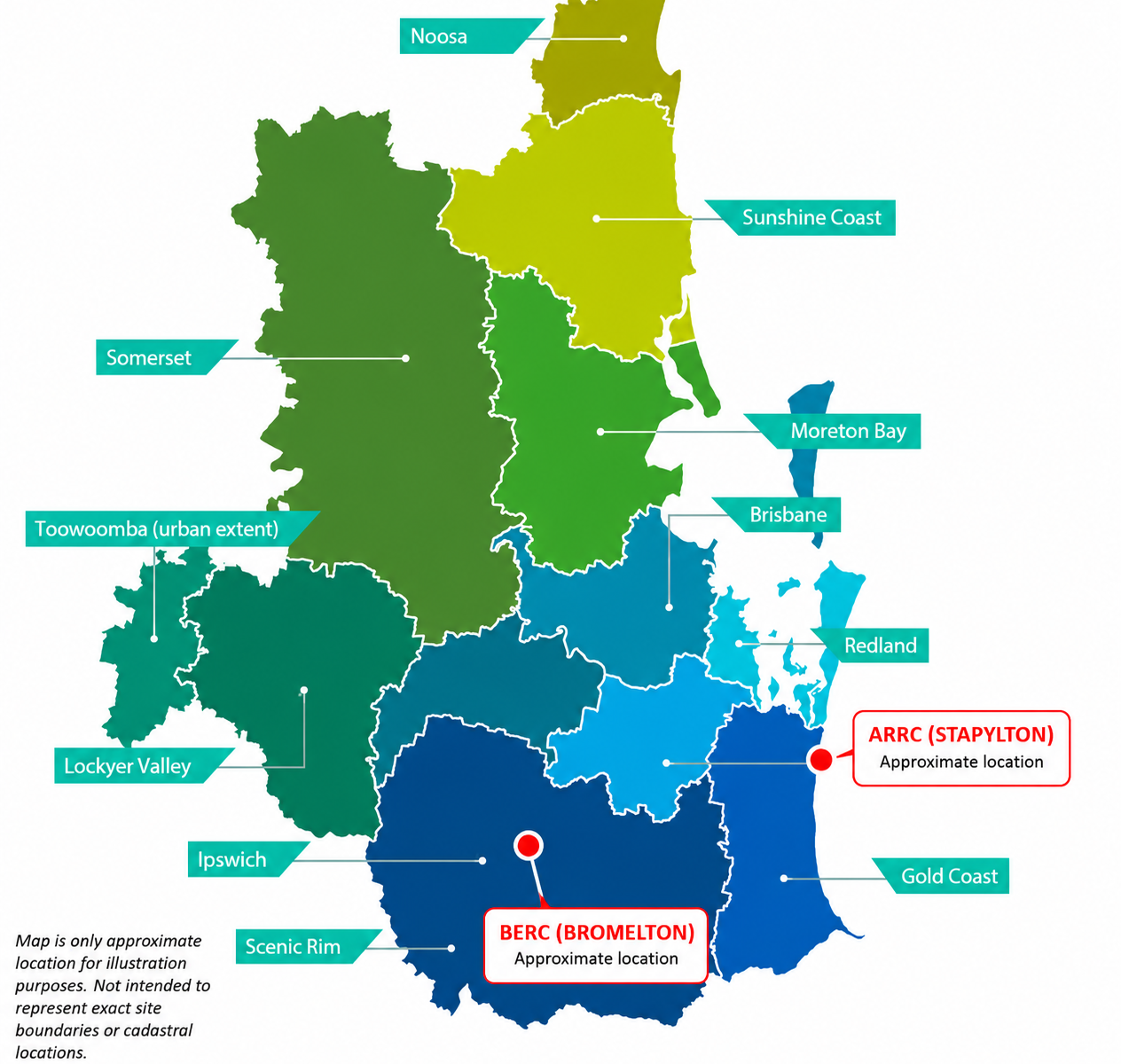
The Competition Question: What Happens If Stapylton Is Approved Too?

This is Part 2 of KC VICE’s investigation into BERC vs Stapylton and the waste supply risk behind BERC. Read Part 1 here.

The proposed Bromelton Energy and Resource Centre (BERC) is often discussed as though it exists in isolation. One project. One facility. One decision.

But what if it doesn’t? What if another major waste-to-energy facility also receives approval?

That question deserves attention because the economics of waste-to-energy facilities are built on one critical requirement. Waste. A lot of it. Every year. For decades.

Feeding The Beast

BERC is proposed to process approximately 760,000 tonnes of residual waste annually. Over a 30-year operating life, that equates to approximately 22.8 million tonnes of waste.

The facility’s operation depends on securing a continuous stream of waste capable of supporting those volumes. Supporters point to South East Queensland’s growing population and increasing waste generation as evidence that future supply will be available.

But there is another question. What happens if multiple facilities are drawing from the same regional waste stream?

The Stapylton Factor

If a major waste-to-energy facility at Stapylton were also approved, South East Queensland could find itself supporting two large-scale facilities seeking access to the region’s residual waste.

That changes the equation.

The question is no longer “Is there enough waste for BERC?” It becomes “How would waste be allocated between multiple facilities?”

At present, no publicly available information appears to explain how future waste streams, council contracts, commercial waste volumes, or industrial waste sources would be distributed if multiple facilities were operating within the same broader market.

Yet those waste streams form a critical component of any waste-to-energy business model.

Lessons From Western Australia

Western Australia currently provides Australia’s largest operating waste-to-energy example. The Kwinana and East Rockingham facilities together process waste volumes broadly comparable to the annual throughput proposed for BERC.

Those projects experienced a range of challenges during development and commissioning, including construction delays, refinancing requirements, cost escalation and corporate restructuring.

That’s not an argument against waste-to-energy. Rather, the experience demonstrates the importance of long-term certainty.

Certainty of waste. Certainty of contracts. Certainty of revenue. These factors are regularly identified as key considerations in major infrastructure projects.

The Public Interest Question

This raises a legitimate question for communities and decision-makers. If multiple facilities ultimately seek access to the same regional waste streams, how has that competition been factored into long-term planning assumptions?

Today that question may appear theoretical. Tomorrow it may become highly relevant.

Waste-to-energy facilities are long-life infrastructure assets that rely on decades of operational planning, contractual arrangements and waste supply forecasts. Understanding those assumptions before approvals are granted is a reasonable public interest consideration.

Follow The Waste

The future viability of any waste-to-energy facility ultimately depends on three things: waste volume, waste contracts, and waste transport.

Until those three factors are clearly understood, it remains difficult for communities to independently assess the long-term assumptions underpinning any proposed facility.

Questions Worth Asking

Before any approval is granted, the community deserves answers.

  • How much waste has already been contractually secured for BERC?
  • How much remains dependent on future agreements?
  • What impact would a Stapylton approval have on BERC’s feedstock assumptions?
  • Have modelling scenarios examined multiple waste-to-energy facilities operating within South East Queensland?
  • What contingency planning has been undertaken if projected waste volumes differ from current forecasts?
  • How would competing facilities affect council waste contracts and commercial waste arrangements?

These are not anti-development questions. They are risk management questions.

The Bigger Picture

The debate should not be reduced to whether one project is good or another is bad. The larger issue is whether South East Queensland’s future waste strategy is being planned as a coordinated system or as a collection of individual projects.

Because if multiple facilities are ultimately seeking access to the same regional waste streams, the public deserves to understand how that system is intended to operate.

The question is no longer whether waste exists today. The question is how future waste streams will be managed, allocated and contracted over the decades ahead.

That answer hasn’t been made publicly available.


This is Part 2 of KC VICE’s investigation into BERC’s waste supply risk. Read Part 1: The Stapylton Waste-to-Energy Competition.

The Stapylton Waste-to-Energy Competition


The Stapylton waste-to-energy proposal rarely gets discussed in the same breath as BERC. Each project gets treated as its own decision, its own approval, its own future. But what if both get up?

What happens if Stapylton gets approved too?

It’s not a hypothetical worth dismissing. The economics of waste-to-energy run on one thing above everything else: a guaranteed, continuous supply of waste. Take that away, or split it, and the whole financial case shifts.

Feeding the Beast

BERC is designed to process around 760,000 tonnes of waste a year. Over a 30-year operating life, that’s roughly 22.8 million tonnes. The facility doesn’t just need waste at opening, it needs committed waste for decades.

Supporters point to South East Queensland’s growing population and rising waste volumes. Fair enough. The numbers look workable in isolation. But isolation is the problem. What happens when two large-scale facilities are drawing from the same regional pool at the same time?

The Stapylton Factor

If a major waste-to-energy facility at Stapylton is approved alongside BERC, South East Queensland would be running two competing operations chasing the same feedstock. The question changes entirely. It’s no longer “is there enough waste for BERC?” It becomes “is there enough committed waste for both, long-term, under contract?”

No publicly available evidence shows how competing facilities would divide future waste streams, council contracts, commercial volumes, or industrial sources. Those contracts are the foundation of financial viability. Without them, the numbers don’t hold.

Lessons from Western Australia

Western Australia is the only Australian jurisdiction with large-scale waste-to-energy operating at anything close to this scale. The Kwinana and East Rockingham facilities together process roughly the same volume BERC proposes to handle alone. Both projects required substantial financial backing, experienced delays, went through refinancing pressure, cost escalation, and administration proceedings.

The lesson isn’t that waste-to-energy can’t work. The lesson is that these projects depend entirely on long-term certainty. Certainty of waste supply. Certainty of contracts. Certainty of revenue. When those foundations shift, the financial pressure comes fast.

KC VICE has previously examined the broader health and environmental concerns surrounding BERC.

The Taxpayer Question

If two facilities end up competing for the same waste stream and volumes fall short, who carries that risk? Private investors? Waste companies? Councils? Ratepayers?

Right now that might look like a hypothetical. It won’t stay that way once billion-dollar infrastructure is in the ground and councils are locked into it for disposal. Governments don’t walk away from essential services when commercial assumptions fail. Airports, ports, toll roads, rail projects, and energy infrastructure have all tested that reality. Waste-to-energy won’t be different.

Questions Worth Asking

Before any approval is granted, the community deserves straight answers:

  • How much waste has already been contractually secured for BERC?
  • How much depends on agreements that don’t exist yet?
  • What impact would a Stapylton approval have on BERC’s feedstock assumptions?
  • Has any modelling examined what competition between two facilities actually looks like?
  • What happens if projected waste volumes aren’t achieved?
  • Would governments be expected to step in if financial performance falls short?

These aren’t anti-development questions. They’re risk management questions. There’s a difference.

The Bigger Picture

This isn’t about picking one project over another. It’s about whether South East Queensland’s waste strategy is being planned as a coordinated system or as a race between competing private interests chasing the same resource.

If multiple facilities end up fighting for the same waste stream, the public deserves to understand that risk before approvals are signed, not after the concrete is poured.

The question was never whether there’s enough waste today. The question is whether there’ll be enough guaranteed waste tomorrow, under contract, for 30 years, across two facilities.

That answer isn’t nearly as clear as the proponents would have you believe.